The tracing algorithm and the human-in-the-loop review
Published
October 16, 2026
This page describes how lowpoly-pdf-to-svg turns a papercraft template into a cut file, and how a person and the program share the work of getting it right. The program does every step it can check itself and fixes what it can prove. It asks the person only about what it cannot decide. Every answer is saved, applied on each later build, and used to train the number reader. The numbers below come from the Bowser model on the current main branch.
The design rests on one observation. A low-poly template carries more than its picture. Every printed edge number appears exactly twice, once on each of the two edges that are glued together. The two edges must be the same length, one of them must sit on a glue tab, and the finished model must fold up and close. These rules let the program check its own trace without any ground truth. Tracing alone, judged by how close the picture looks, cannot catch these errors. The benchmark shows that visual metrics barely react to them.
Pipeline
flowchart TD
  pdf[PDF template] --> render[1 Render pages]
  render --> detect[2 Detect pieces, cuts, folds, number marks]
  detect --> read[3 Read numbers: Tesseract + digit matcher]
  read --> hand[4 Apply saved hand fixes]
  hand --> joint[5 Joint repair: look-alikes, mirror twins]
  joint --> check[6 Self-checks: pairs, junctions, scale, 3D fold-up]
  check --> out[Inkscape SVG, edge table, status page]
  check --> cards[7 Check page: only what is left in doubt]
  cards -- "corrections, lines, piece fixes" --> hand
  cards -- "corrected digits" --> read
One build (make). Grey boxes run without a person; the check page is the only step that needs one, and its saved files feed the next build.
1 Render
pdftoppm renders each page listed in the project YAML at 180 dpi. The YAML assigns each page to a cardstock colour and names the fold styles the template uses. All later geometry is in millimetres, using the page’s own scale.
2 Detect
The template prints three kinds of ink, and detect.py separates them:
Cut lines are solid grey strokes that enclose each piece. A piece is the background area fully enclosed by cut lines. Its outline is traced and then reduced to corner points joined by straight segments, because a low-poly piece has no curves. Each segment is fitted to the printed line, and a corner is kept only where the ink turns.
Fold lines are dashed (valley) or dash-dot (mountain) grey strokes. Dashes are thinned to centrelines and merged when collinear. Each fold is refitted to its dashes and stretched from cut to cut, ending on a corner. Its style is read from the dash pattern under it.
Edge numbers are the darkest ink. Glyphs are grouped into number marks, and each mark is attached to the cut edge or tab fold it labels. Ink that belongs to no piece stays on the Review layer, so nothing disappears silently.
3 Read numbers
Every number mark goes to two readers. Tesseract reads it in both orientations. A small digit matcher is trained on the page itself, using digits from reads Tesseract is sure of plus every digit a person has corrected. A reading is accepted when both readers agree, or when Tesseract alone is very sure (confidence 93 or higher).
The remaining marks are settled together, not one at a time. Since every number is printed twice, an uncertain mark prefers a close candidate reading that completes a pair. Any number not printed exactly twice is flagged.
4 Apply saved fixes
Three files in the model folder hold what a person has decided. Each build applies them after reading, so nothing has to be corrected twice.
file
holds
matched by
number-corrections.csv
what a number should say (or that it is not a number)
the nearest mark on that piece, within 2 mm
piece-edits.csv
folds added or dropped, corners moved
the nearest fold or corner
number-lines.csv
the line a number marks, drawn by hand
the number’s mark
After a piece changes, its numbers look for their lines again.
5 Joint repair
Each edge number is now checked against its partner. The edge table (edge-numbers.csv) gives every number one status: ok (one plain edge and one tab, lengths within 1 mm), unpaired, length mismatch, no tab, both tabs or extra copy. Two kinds of evidence then fix numbers without asking.
Look-alike misreads. Take a number that did not pair up. If an unpaired line of the same length on the other side (edge against tab) carries a number that looks like a misreading of it, the two are matched. The evidence is OCR’s own second choice, or a single differing digit. A match is applied only when it is clear-cut: OCR offered the suggested number, the lines agree within 0.3 mm, neither copy has another candidate, and the suggested number has no clean pair yet. In addition, either the read number already pairs elsewhere, or the copy being fixed was a shaky read (confidence below 80) while its partner was not. Any other match becomes a suggestion for the person.
Mirror twins. Most pieces have a mirror twin cut from the same cardstock. Twins are found by walking round each piece and comparing the lengths of its numbered lines with another piece’s lengths walked the other way. An exact mirror also matches tab for tab; a variation has its tabs on other edges. Pairing every numbered line with its mirror line gives three checks:
A line and its mirror should be the same length; if not, one was traced wrongly.
A fold on one twin with nothing at the mirror place on the other is probably a missed fold.
Glue pairs mirror too, so a clean pair on one side predicts the number on the other side.
6 Self-checks
checks.py looks for faults that need no ground truth:
a fold that meets the cut between two corners (a corner was missed);
a cut line that runs on past a traced corner (the corner was clipped);
a piece traced twice, or a tiny outline with no folds or numbers;
a page whose glued pairs are all slightly longer or shorter than their partners (a scale error).
Each fault is written to the edge table at the numbers it touches.
The 3D fold-up (make -f fold3d.mk, 3D fold-up) is the strongest check. It folds every piece along its scores, glues each numbered pair and measures the gap left. A misread number or a mis-traced line usually shows up as a glue that will not close.
On Bowser, the program read 1573 numbers on 178 pieces. It was sure of 1450 without help. It fixed 0 further numbers itself: 0 look-alike misreads and 0 predicted from mirror twins. Mirror twins pair up 786 numbered lines (52 of them on exact twins); 3 differ in length from their mirror line. The self-checks flag 16 trace faults. In the 3D fold-up, 712 of 739 glued edges close.
Human in the loop
The aim is that the person spends time only where the program is unsure, and that each answer improves later reads as well as fixing this one. The review happens on one local page, app/number-check.html. make fix writes its data (check-page.json, with crops of the scan, which stays local because the pattern is personal-use only). The page opens the model folder and saves straight back into it.
What the person is asked
The program sorts what it found into cards. Each card shows the scan around the number beside the scan around its partner, with the traced line drawn on both.
card
when
the person
Fixed for you
a clear-cut look-alike or mirror fix was applied
can glance and override; no answer needed
Suggested
a likely misread, not clear-cut enough to apply
confirms the suggestion or types the right number
Doubt
a hand correction that still does not pair
rechecks the correction, its partner or the line
Open
a number with no explanation
types the number, marks it not a number, or draws its line
A hint on each suggestion says whether the 3D fold-up agrees: the two pieces meet when glued on that number. By default the page shows only open cards. Fixes the program made itself are listed under Fixed for you.
The piece review works the same way for geometry. Twin pieces are shown side by side and sorted by how much likely needs fixing. That score counts trace faults, untraced line ink inside the piece, numbers that found no fold, and folds the mirror twin has but this piece lacks. Missing folds are drawn in orange. The person adds or drops a fold, moves a corner, or marks the piece OK. The style of an added fold is read from the dashes printed under it.
What happens to an answer
Saving writes the three fix files from step 4. The next build (make redo, which reuses the saved trace of untouched pages) applies them, reruns joint repair and the self-checks, and rebuilds the cards. Fixing one number can complete a pair, and that can settle a mirror prediction or close a glue in 3D. One answer often clears more than one card.
Corrections also feed back into reading. Each corrected number teaches the digit matcher its digits, upright as Tesseract turned them. Freshly traced pages therefore read better than the first pages did.
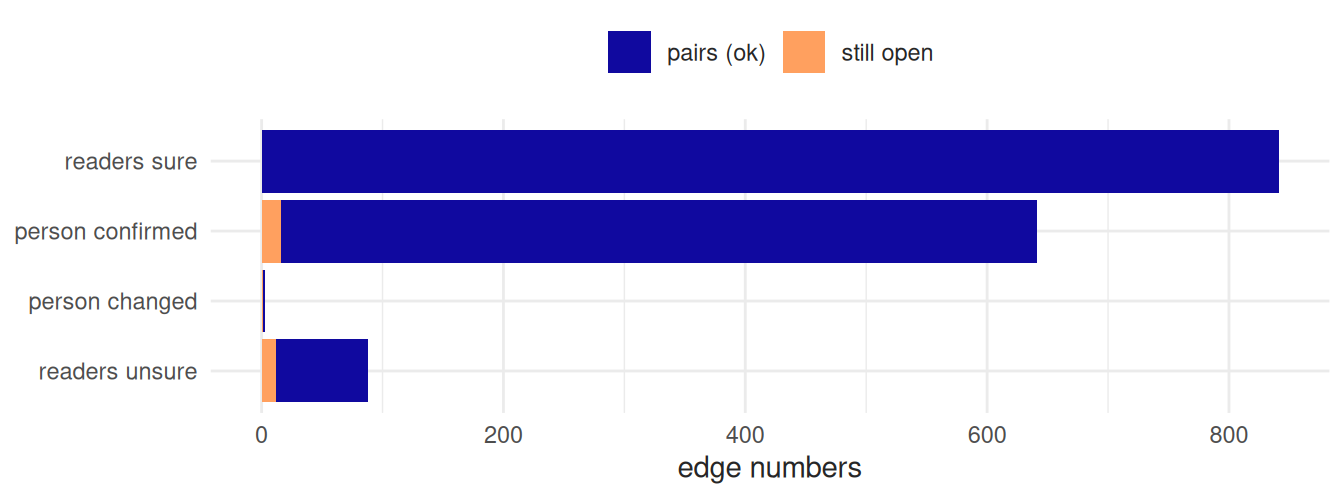
Figure 1: Where each edge number’s final reading comes from. Confirmed means a person checked the number and kept the reading; changed means they typed another one.
So far the person has answered 646 number cards: 641 confirmed the reading and 5 changed it. The piece review holds 275 piece edits (add 54, drop 4, move 31, note 8, ok 178), and 74 lines were drawn by hand (cut 45, fold 29). 1544 of 1573 numbers pair cleanly; the rest are still open.
Why the review is split this way
Three rules shape it.
Act only on proof. A fix is applied without asking only when several independent checks agree: the reader’s own alternative, matching lengths, a single candidate, and no clash with an existing pair. A wrong automatic fix costs more than a question, because a person would have to find it first. Every automatic fix stays visible and can be overridden.
Ask with the evidence on screen. A card shows both copies of the number and the line each one marks. The person judges a pair, not an isolated digit.
Keep every answer as data. Corrections are plain CSV files kept in git. They make builds reproducible, they train the reader, and they form the record of human effort that research question 3 needs (#9).
Research use
The pipeline is the system evaluated in papers 2 and 3. Paper 1 benchmarks existing methods only.
Joint reasoning (#8). Each repair source can be switched off: pair-up during reading, look-alike fixes, mirror twins, self-checks and the 3D hint. Rerunning without one measures what it adds. The ablation runs have not been done yet.
Correction effort (#9). The corrections file records what was decided but not how long it took, and not what a person would have had to look at without triage. Logging time per card, and replaying the saved corrections on an exhaustive review order, is the next step.