in Business Intelligence

Designing Authentic Industry-Engaged Assessment for Professional Competence

22nd International CDIO Conference · June 23rd, 2026

Motivation

Academia

aims to prepare students for professional practice, but offers limited guidance on how to operationalize this in course design and assessment

Industry

expects credible, reproducible results supported by clear reasoning and usable for decision-making

Underlying mismatch

what counts as “good work” differs between academic and professional contexts

Context: Business Intelligence

Overview

  • 6 ECTS course
  • advanced undergraduate and early graduate students
  • 10–15 students, two teams

What is BI?

data-driven decision support

  • data analysis
  • systems integration
  • communication to inform organizational decisions

Goal: strengthen industrial relevance and professional competence

Industry-engaged project

Sustained industrial context

a single dataset and domain used across the entire semester

Industry partner role

  • problem framing
  • milestone discussions
  • final evaluation

Dual context

academic and industry perspectives coexist throughout

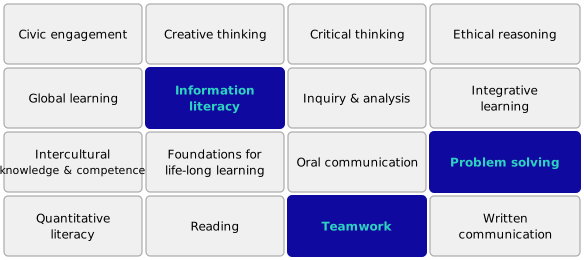
Design focus: LOUIS-guided

Focus on a small set of competences within a sustained industry context.

LOUIS — Learning Outcomes in University for Impact on Society (Aurora University Network). Focus on a small set of competences (max 3).
Pedagogical structure
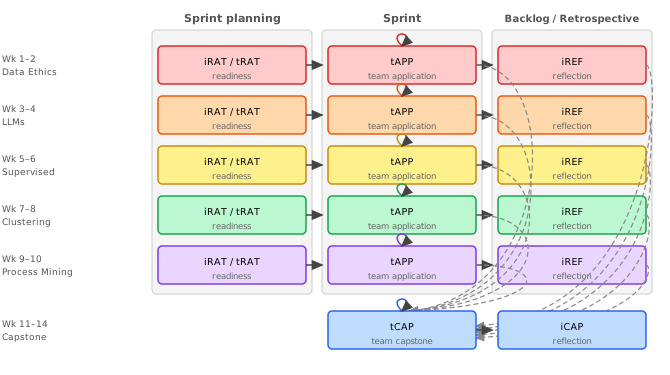
Team-Based Learning: iRAT (individual readiness)  ·  tRAT (team readiness)  ·  tAPP (team application)  ·  iREF (individual reflection)

Flipped classroom  ·  Iterative modules leading into capstone  ·  iRAT/tRAT use is slightly unconventional

Assessment as development

Core mechanism

One rubric, many iterations

same assessment rubric reused across all modules and the capstone

  • analytical soundness
  • transparency
  • reproducibility
  • stakeholder relevance

Developmental shift

feedback is carried forward — not reset between tasks

Standards fixed; performance expectations scaled during the learning phase.

Evolving feedback

Instructor

  • method
  • implementation

Industry partner

  • domain relevance
  • decision context

Student

  • knowledge transfer through PRs
  • defending decisions
  • critiquing peer work

Progression over time

  • align within teams
  • cross-team review
  • industry validation

Audience shift

from internal review to external scrutiny

Credibility and trust

Industry threshold

credibility is fragile: early issues can undermine trust in the entire result

What is evaluated

  • reproducibility
  • transparency
  • clear assumptions

Shift in communication

build trust first — then invite inspection

Students are told to present to sell — then invite the partner to read the codebase if curious, and the final report if they want the full picture. (The report is what I grade — the partner never needs to.)

Indicative evidence

Students & graduates

  • high engagement without attendance requirements
  • transfer of reproducible workflows
  • stronger documentation practices

Academic perspective

more ambitious, student-driven projects

Industry perspective

improved coherence and credibility; results could be implemented in practice

What this design makes visible

Transferable principles for CDIO-aligned, industry-engaged courses.

Sustained context

one domain, all semester — depth over breadth

Assessment as iteration

same rubric, feedback carried forward — not reset

Visible contributions

accountability without fragmenting the team

Widening audience

from internal review to industry scrutiny

Accumulated feedback

unresolved issues stay visible across submissions

Tooling as support

design comes first — tools enable it

Questions?

Dr. Helga Ingimundardóttir

Team and individual accountability

Team-level

  • analytical quality
  • coherence
  • relevance

Individual-level

  • visible artifacts
  • documented contributions
  • structured reflection

Design goal: accountability without fragmenting teamwork — designed into the course architecture, not added after the fact.